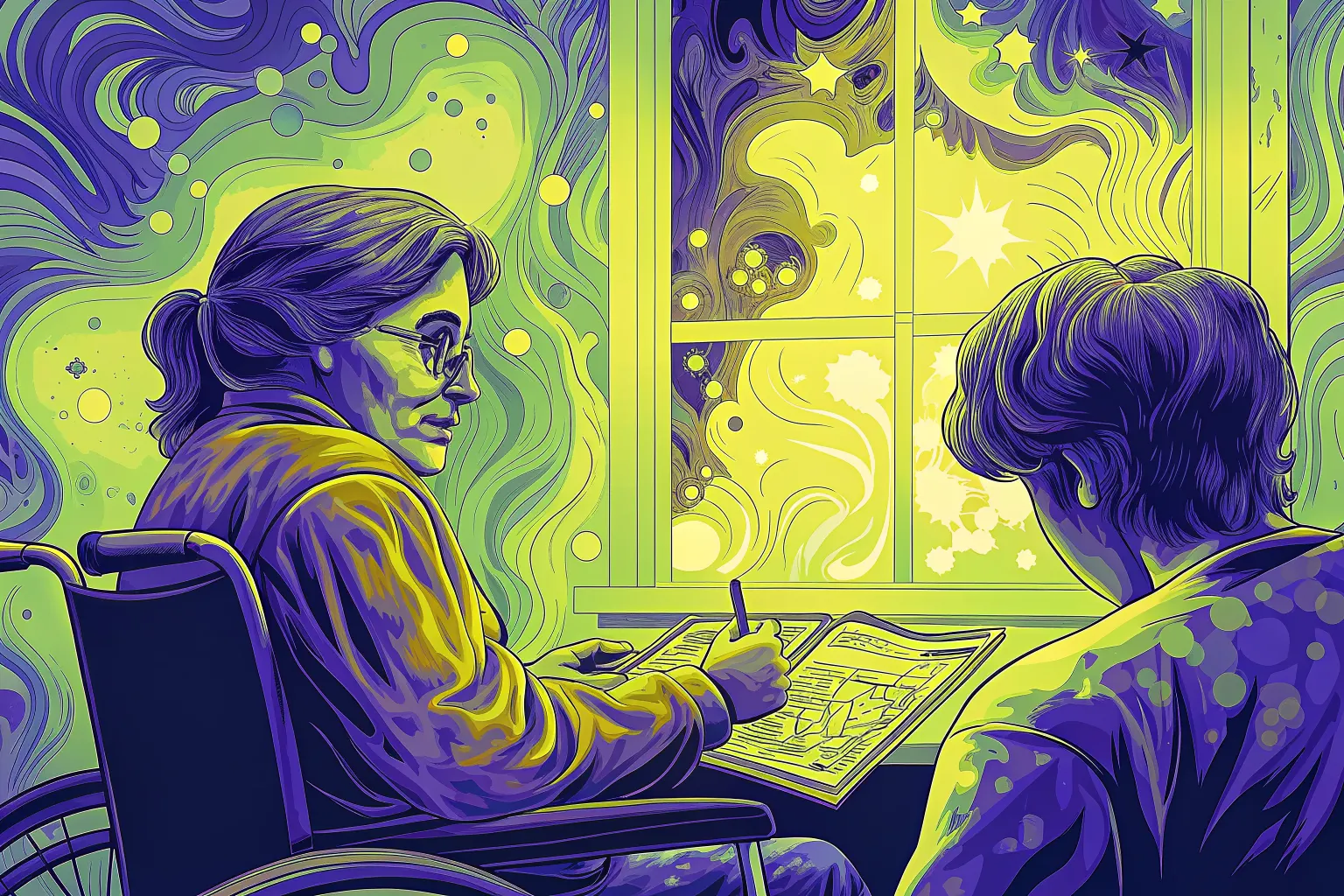
Draws this one again — same subject and the same people, a new palette and a new angle on it, described afresh. It replaces the drawing on this page for everyone, until somebody draws another. Costs the site about eight cents, and a few seconds.
Or press ←the left arrow and →the right arrow.
What does the thirtieth study tell you that the first does not?
Writing — read the piece
- Asked for
- A daylit research room where a seated participant reads a refreshable braille display and a researcher takes notes beside them
- Drawn with (analogous)
#c0d54b#93b86a#7a58c7
Why these three
Two neighbours reading as one family, and a third opposite them to argue with it.
- SeedSHA-256 of
what-does-the-thirtieth-study-tell-you, which is the same every time and different for every piece. - Base hueThe first two bytes as a fraction of 65,535, times 360 = 62°.
- GeometryThe third byte modulo 4 picks analogous, which adds 0°, 35°, 190°.
- WobbleThree more bytes shift each by up to ±12° — +6.6°, −8.5°, +5.9° — so two pieces that draw the same geometry are still not the same shape on the wheel.
- Result
#c0d54b69° at 65% saturation, 83% value#93b86a89° at 42% saturation, 72% value#7a58c7258° at 56% saturation, 78% value
Saturation never drops below 72% and value never below 78%, which is what keeps a hue reading as the colour it was chosen to be rather than as a dark. More on how these are made.