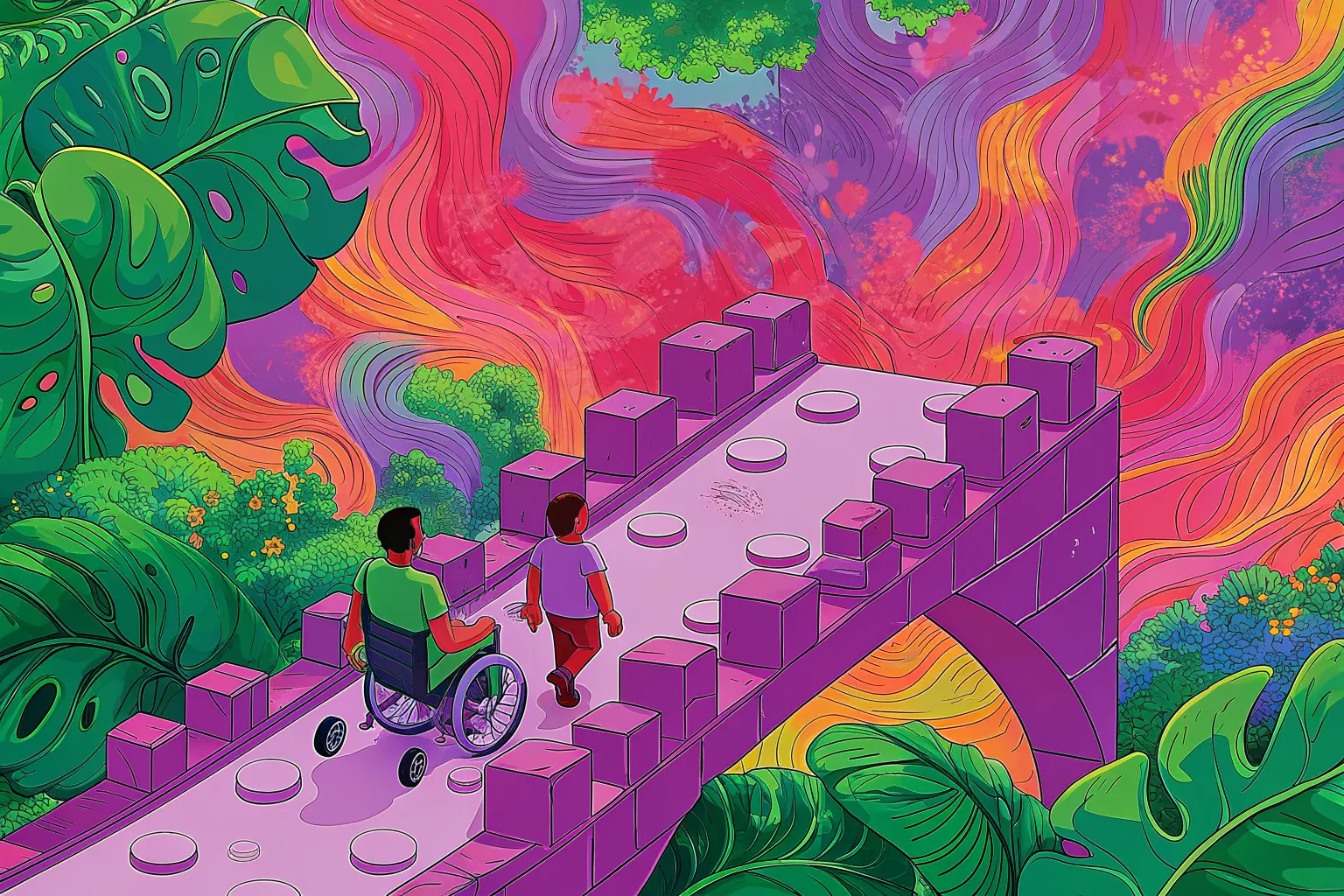
Draws this one again — same subject and the same people, a new palette and a new angle on it, described afresh. It replaces the drawing on this page for everyone, until somebody draws another. Costs the site about eight cents, and a few seconds.
Or press ←the left arrow and →the right arrow.
What happens when the design system makes the decisions?
Writing — read the piece
- Meant to show
- The people crossing: the same bricks, built into something everyone stands on, so a weak brick fails under all of them at once.
- Asked for
- Plastic toy building bricks snapped together into a full-size footbridge over a stream, people walking across it, one of them using a wheelchair, a few loose bricks still on the bank
- Drawn with (complementary)
#2d9745#c05ac7#579991
Why these three
Two hues opposite each other, the strongest contrast available, with the third supporting the first.
- SeedSHA-256 of
what-happens-when-the-design-system-makes-the-decisions, which is the same every time and different for every piece. - Base hueThe first two bytes as a fraction of 65,535, times 360 = 127°.
- GeometryThe third byte modulo 4 picks complementary, which adds 0°, 180°, 40°.
- WobbleThree more bytes shift each by up to ±12° — +6.5°, −11.2°, +6.2° — so two pieces that draw the same geometry are still not the same shape on the wheel.
- Result
#2d9745134° at 70% saturation, 59% value#c05ac7296° at 55% saturation, 78% value#579991173° at 43% saturation, 60% value
Saturation never drops below 72% and value never below 78%, which is what keeps a hue reading as the color it was chosen to be rather than as a dark. More on how these are made.