
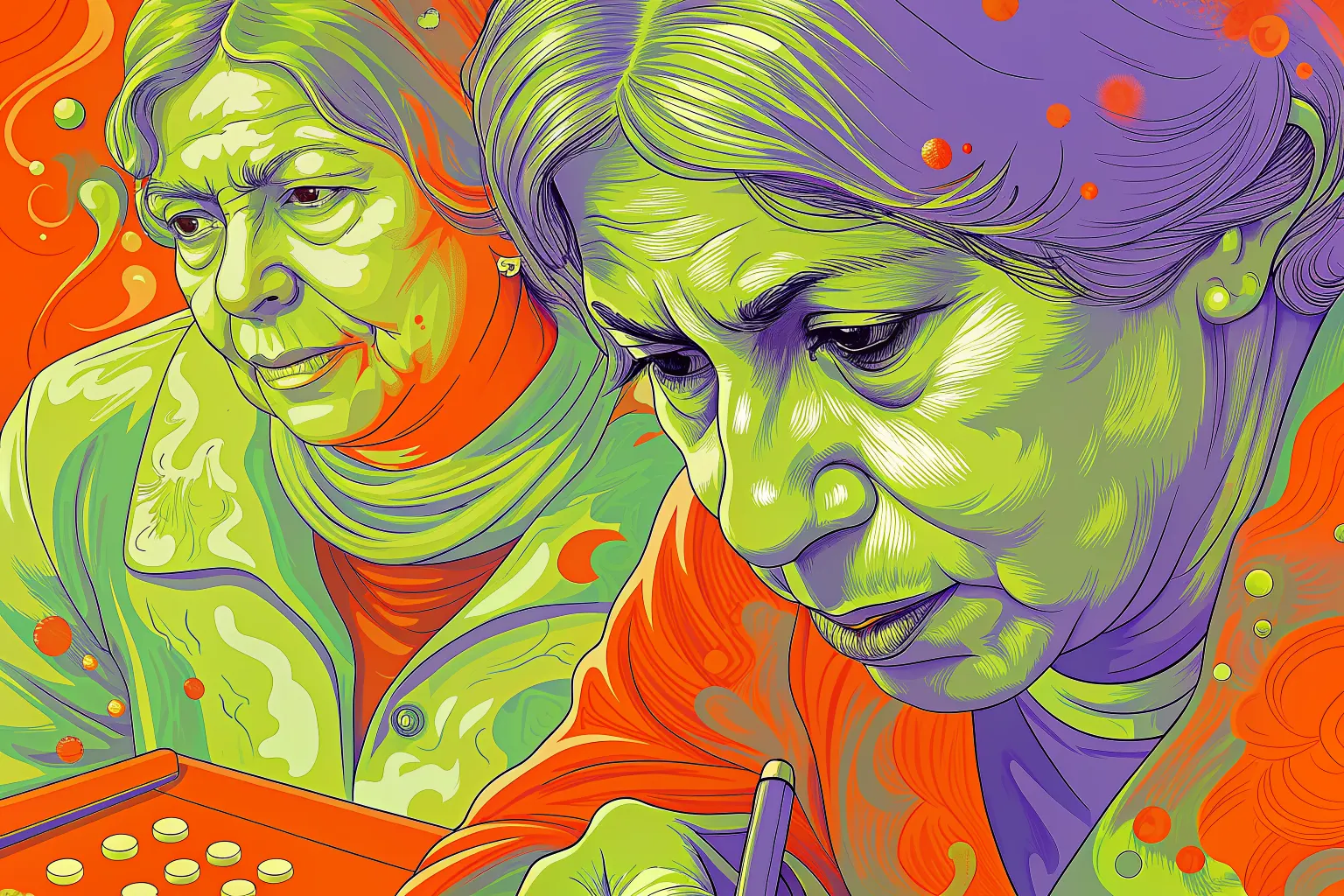
What does the thirtieth study tell you that the first does not?
I ran accessibility research for years before I ran enough of it to find out that the people I was learning from disagreed with each other.
Listen to this essay
Nobody watches one sighted participant miss a button and writes "sighted users miss buttons" in the summary. Yet everybody watches one blind participant struggle with a table and writes "blind users need."
One person becomes a population as soon as the population is small and unfamiliar to us, and that should embarrass us. I wouldn't call the result a finding. It's a stereotype, even with a recording attached.
The opposite failure is harder to notice, and it looks more rigorous. A real finding gets set aside because it came from one person, in a study of one, with nothing to weigh it against.
It's a bit like asking for directions. Ask one person and you get a route. Ask thirty, and you find out the town has two stations, and most people assumed you meant the other one.
For a long stretch of my career, accessibility research was the first kind of asking.
I wouldn't talk anyone out of that first session, though. Something real happens the first time a team includes a disabled participant: the room stops arguing from imagination. For most teams, it's the single biggest change available.
It buys less than we pretend, that's all. One session can't tell us whether we watched a pattern or a person. So it gives us a feeling, when we needed a direction.
Thirty sessions showed that participants disagree
At the Rhonda Weiss Center, under a multiyear Department of Education grant, I led design for a system that publishes IDEA data. That data is what states report about how children with disabilities are served.
We ran more than thirty usability studies with disabled participants, including blind and neurodivergent users, around a stakeholder group of about eighty people.
I didn't expect them to disagree with each other, and I now think that disagreement is the whole point. They didn't disagree about whether the thing worked. They disagreed about what a good answer looked like.
Participants using screen readers didn't all want the same treatment of the same table. People navigating by keyboard didn't want what people using magnification wanted.
Participants who read dense text quickly asked for the opposite defaults from participants who don't. And each of them was right about themselves.
So past a certain number of sessions, what do blind users need stops being a question with an answer. What we get back is a range, and that range is the finding.
A range is harder to hear than a defect list, because we can finish a defect list. If thirty people all hit a control with no name, we name it, and the work is done.
If thirty people want three different reading orders, there's nothing to fix.
What we have instead is a decision: which default ships, what becomes adjustable, and what gets offered as a second route to the same meaning.
That costs more. But it's ordinary design work, and we already know how to do it everywhere else. Nobody ships one font size and considers the argument settled.
Only in accessibility have we been allowed to treat a group of people as having one set of needs, mostly because we had met one of them.
Plurality is the word I'd put on it. We include disabled people in research to stop designing for a composite who doesn't exist. We aren't there to acquire a spokesperson.
Posts like this usually skip the cost, so here it is. Thirty sessions is mostly logistics, and recruitment has to reach past the same few people who always say yes.
Scheduling has to fit the assistive technology the participant actually uses, which may not be the one we happen to own.
People have to be paid, because unpaid consultation selects for those with spare time. And sessions overrun, because the setup did.
A multiyear federal grant paid for all that, and a product team on a quarterly cycle has a harder case to make. I'm not going to pretend otherwise.
But the sessions themselves were almost never the expensive part. The expense was everything arranged around them, and that's mostly a budgeting and scheduling problem.
Teams rarely stop at one study because they learned enough. They stop because nobody owned the logistics of the second one.
Three sessions are enough to find a disagreement
- Run three sessions, not one. Three isn't statistically anything. But it's enough to surface one disagreement, and one disagreement changes how a team talks for the rest of the project.
- Recruit for difference inside the group. Two screen reader users with different tools and different experience will teach you more than two who match.
- Pay everyone, at the rate you pay any other participant. This is the line most likely to be cut. And it decides who can afford to show up.
- Stop writing findings as "blind users." Write "two of the three participants using screen readers." It's longer, and it's true.
- Book the second study before the first one runs. In January, it costs nothing.
- Keep the disagreements in the report. A summary that resolves every conflict into a single recommendation has thrown away the most expensive thing you bought.
Putting one disabled person in the room, once, is better than nothing. But it's a version of the mistake I started with. One voice still stands in for everybody, and we're the ones who picked it.
So look at the last research plan you wrote, and count the sessions that included disabled participants.
If the number is one, I wouldn't start by asking what you learned from it. I'd ask what the second session would have told you.
About the drawing
The drawing for this piece was generated, not chosen. Hashing the piece’s name fixes one point on the color wheel; the other two follow from it. The same name always gives the same three colors.
#c0d54b#93b86a#7a58c7The line under the drawing marked “Meant to show” is written by a person, not the model. A generated drawing keeps what is large and loses what is small, so the detail that decides who someone is can go missing, and a picture only reaches people who can see it. Where the drawing and that line disagree, the line is the intent.
Or press ←the left arrow and →the right arrow.