

What would you ask your future self?
In this time-travel activity, I propose an activity that focuses on creating an inclusive mindset from the standpoint that a lack of disability is, in fact, only temporary.
Listen to this essay

"Although the world is full of suffering, it is also full of the overcoming of it."
- Helen Keller
Most of us design as if our bodies and minds will stay the way they are today. But they won't. Not being disabled is, for most of us, temporary.
This is a workshop built on that idea. You interview your future self, and in doing so, you find out who your design leaves out today.
Our past drives our design decisions
We're shaped by how we were brought up and the way we think. We're shaped by our past and current relationships, our circle of friends, how fast we move and how anxious we get about little things. And those things shape our style, the way we write, the colors we choose and the way we design products.
But we forget one thing. Our bodies and minds keep changing, toward needing more and more care.
So knowing that disability or a change in how we live is likely could make us more aware of who we're excluding today. If we expect to lose some of the abilities we have now, we design more inclusively.
After this activity, you will:
- learn from past mistakes
- spot missed opportunities
- see how new technologies, techniques or methods could have helped past projects
- think about disabilities you may have as you grow older
- account for world events that could change how we live
Don Norman changed his mind about who design is for
I came across an article by Don Norman, titled I wrote the book on user-friendly design. What I see Today horrifies me (opens in a new tab).
Don Norman is one of the founders of user experience, and in the 80s he wrote a popular book, The Design of Everyday Things (opens in a new tab).

"I wrote the book on user-friendly design. What I see today horrifies me. (opens in a new tab)"
- Donald Norman, 2019
The Design of Everyday Things by Don Norman, 1988. Illustration by Zachary Monteiro
In the article, he describes how little he knew about his own future when he wrote that book, back in 1988:
"Do not think that thoughtful design is just for the elderly, or the sick, or the disabled.
In the field of design, this is called inclusive design for a reason: It helps everyone."
- Donald Norman, 2019
It made me think about how biased we are toward our own present, our conditions, abilities and mindset, when we design for other people.
Think about it. We're a collection of our past, not our future. We're shaped by how we were raised, by whether we met different beliefs, and by how many relationships we had along the way, and how many heartbreaks.
So whatever our profession, we make decisions the way our present self draws on all of that past.
Interviewing your future self
As a product designer, I think constantly about the people who will use what I design. But what if I were blind myself? How different would my designs be?
That question led me to create this inclusive design activity, which helps teams build empathy toward older adults and disabled people.
Imagine for a moment that your future self visits you. They've come back from 30 years in the future, for an Ask Me Anything session with you, today.

Two Marcelos appear next to each other, one looks much older, the younger Marcelo looks at their older-self with a surprisingly funny face.
You weren't given much notice, so you'll have to think fast, and come up with some questions to ask your future self.
What would you ask someone from the future?
The activity comes in two parts
- Ice breaker: a fun way to connect participants with their older selves.
- The interview: four simple steps that help participants come up with, choose and answer imagined questions, followed by a moment to reflect.
Part 1: Ice breaker
Picture yourself as an older person, using the face-aging app FaceApp.
- Audience: anyone who wants to reflect on how people change over time
- Duration: 5-10 minutes
- Outcome: a fun way to empathize with your future self
- Preparation: download the app from one of these app stores:

Download the FaceApp application by scanning one of the QR codes displayed on this image.
- Using the app: follow these steps:
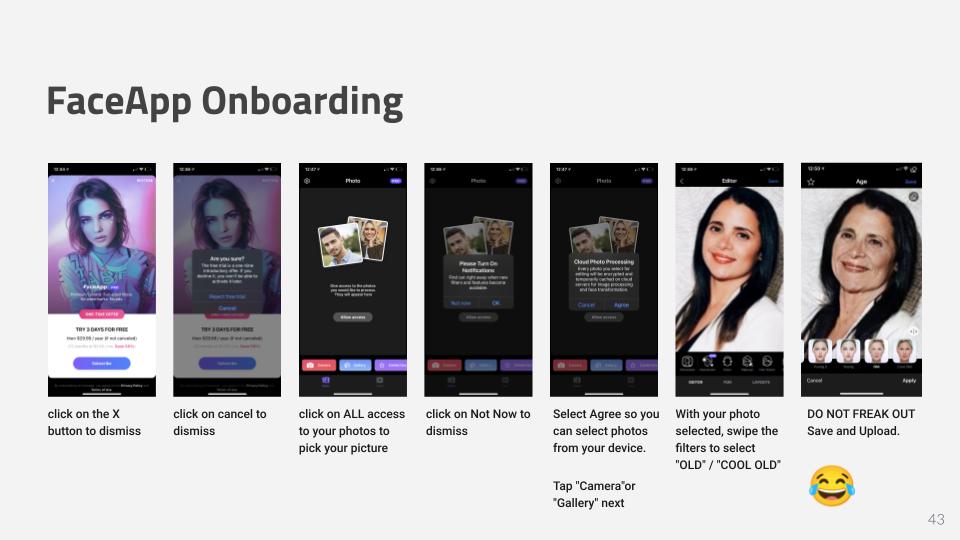
Step-by-step instructions on how to use the FaceApp. Credits to Laura Bries.
Part 2: The interview
- Preparation: download the worksheet (opens in a new tab), and bring the photos from the ice breaker
- Audience: anyone who wants to reflect on how people change over time
- Duration: 5-10 minutes for each step
- Outcome: an open discussion about how our behavior today affects others, and how changes in society shape our values

Worksheet created by Marcelo Paiva inviting designers to think about their future self and the disabilities they may acquire over the years.
Step 1: Write your questions
Imagine you could interview your future self. Someone much wiser and more experienced, who has survived some hardships in life. Who has seen the good in society, and new inventions, and been treated with the latest advances in science. What would you ask?

Example for creating questions for each category.
These categories can help spark some questions:
- Living: How has the future changed the way you live?
- Health: Has your health declined?
- Relatives: Has your family grown or shrunk?
- Professional: How much has your working life affected others?
- Disabilities: Have the years brought you any permanent setbacks?
- Technology: How has the rapid growth of technology changed society?
- Society: Have gaps like gender, wealth and racism affected your life, or the world?
- Bias: Have you become aware of your own bias toward particular groups?
- World: Have any disasters disrupted humanity?
Step 2: Challenge your questions
This step helps you choose the most important questions, with a twist. What if:
- you could ask only one question?
- you had only 30 seconds?
- you could ask about only one of the categories above?
And a bonus: what if you assume a future disability?
Choose your final questions, and get ready to meet your older self.
Step 3: Listen to your future self
Take the photos from the ice breaker. Spend a few seconds looking at your older self. Then ask your questions.

Example of the photos converted using the FaceApp. Leonardo DiCaprio and Kanye West and shown in three photos each. From left to right, they appear as young as 10 years ago, as they are Today and as they would look like 40 years from now.
Step 4: Reflect on what needs to change
Take a moment to think about the answers your future self might have given:
- What advice or wisdom did you receive?
- Was your future self someone who changed the world?
- What disabilities had your future self acquired, and how did you get past any barriers?
- What did this person say about the things we take for granted?
- Will you change the way you design or work?
Once everyone has had a chance to share, ask the group to set some goals to improve their lives. What small things can you change today that will help your life in the future?
In my case, my future self told me:
Marcelo, you will have diabetes and severe hearing loss, but your faith will help others.
And gave some tips:
It is never too late to exercise, meditate, and learn American Sign Language.
Disability and ageism are closer than they look
We all have the chance to change our bias toward who we are today. That's why this exercise is for anyone who designs for others, and assumes nothing will ever change in their own life.
- 61 million adults in the United States live with a disability.
- 26 percent (one in 4) of adults in the United States have some type of disability.
So think about how we treat older people, and how we talk about older colleagues or family members.
Ageism is stereotyping and discrimination against people because of their age, and we've all been aging since the day we were born.
If you have questions, or want help bringing this workshop to your team or organization, contact me on linkedIn (opens in a new tab).
Tulane University's Design Thinking Breakfast
I first presented this deck in November 2020 at the Phyllis M. Taylor Center for Social Innovation and Design Thinking at Tulane University, as a guest speaker in their Design Thinking Breakfast series.
Please review the Google Slide presentation and don't hesitate to connect if you have any comments or questions.
Credits
Cover Photo by Glen Hodson on Unsplash
Next: recognize exclusion
Read the essay I co-wrote for the UXPA Journal of Usability Studies (opens in a new tab), about the first principle of inclusive design, recognize exclusion. It's the #1 principle.
About the drawing
The drawing for this piece was generated, not chosen. Hashing the piece’s name fixes one point on the color wheel; the other two follow from it. The same name always gives the same three colors.
#3d59a9#a15e3b#99a448The line under the drawing marked “Meant to show” is written by a person, not the model. A generated drawing keeps what is large and loses what is small, so the detail that decides who someone is can go missing, and a picture only reaches people who can see it. Where the drawing and that line disagree, the line is the intent.
Or press ←the left arrow and →the right arrow.